May 13, 2026
Content
Fire protection holding tanks provide a guaranteed, dedicated water reserve for automatic sprinkler systems, hydrant networks, foam suppression systems, and fire hose reels — independent of the municipal water supply. This independence is the central requirement driving their specification: fire authorities and insurance underwriters need assurance that the full design flow rate will be available for the full design duration, regardless of supply pressure fluctuations, pipe bursts, or simultaneous demand from other building systems.
In many jurisdictions, a dedicated fire reserve is not optional. NFPA 22: Standard for Water Tanks for Private Fire Protection (USA), BS EN 12845 (Europe), and equivalent national standards in Australia, the Middle East, and Southeast Asia mandate minimum tank capacities, structural performance requirements, and filling and outlet configurations as conditions of fire system approval. A system that draws from the potable water supply without a break tank or dedicated reserve typically fails these compliance tests.
Beyond compliance, dedicated storage eliminates the risk of fire suppression demand competing with domestic water use during an emergency — a scenario that has contributed to suppression system failures in documented fire incidents where shared supply infrastructure was undersized.
Sizing a fire protection storage tank requires calculating the volume needed to sustain the fire suppression system at its design flow rate for the full required duration — then adding a margin for system inefficiency, pipe filling, and hose allowances. The calculation is driven by the hazard classification of the occupancy and the suppression system type.
A typical light-hazard sprinkler system under EN 12845 requires a design flow rate in the range of 375–750 liters per minute for a duration of 30–60 minutes, producing a minimum storage requirement of roughly 11,000–45,000 liters before pump efficiency and hose allowances are added. Ordinary and high-hazard occupancies scale significantly beyond this — large warehouse or industrial sprinkler systems routinely specify tanks of 200,000 liters or more.
Where a combined sprinkler and hydrant system draws from the same tank, the hydrant flow allowance — typically 1,000–2,000 liters per minute for 45–60 minutes under most regional standards — must be added to the sprinkler demand, not calculated as an alternative. This additive approach often doubles the required tank volume compared to sprinkler-only calculations.
The tank's total geometric volume and its usable fire reserve volume are not the same figure, and conflating them is a common sizing error. The following volumes must be accounted for and deducted from total capacity when confirming compliance:
Most standards require the tank to be capable of refilling to its full fire reserve within a defined period — commonly 24 hours under NFPA 22 and between 4 and 36 hours under various EN 12845 risk categories. The refill rate determines the minimum bore of the inlet valve and supply connection. A ball float valve or electrically actuated fill valve sized to the refill rate specification must be confirmed during hydraulic design, not assumed from standard plumbing components.
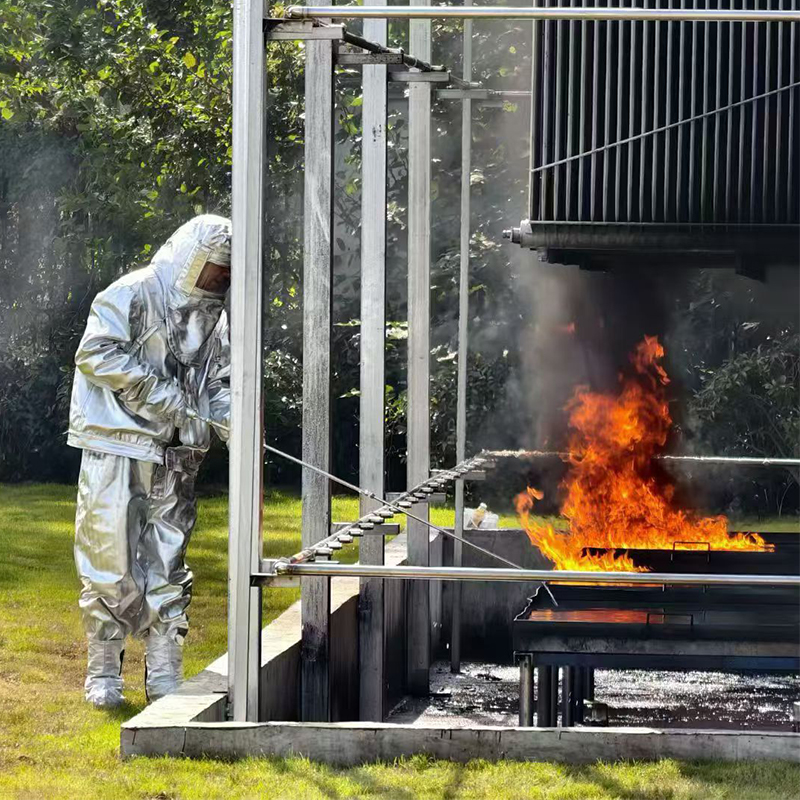
Correct installation of fire protection holding tanks is as critical as correct sizing. A tank that meets the volume specification but is incorrectly sited, inadequately supported, or improperly connected to the suppression system will fail during commissioning inspection or — worse — during an actual fire event.
Fire protection tanks are installed at ground level, below ground (underground cisterns), or elevated (gravity tanks at height sufficient to generate the required system pressure without a pump). Each location imposes different structural requirements:
The pipework connections to a fire protection tank must comply with standard configurations that prevent cross-contamination with the potable supply and ensure reliable operation under emergency conditions:
In cold climates, fire tanks and their associated pipework must be protected against freezing — a frozen tank is operationally equivalent to no tank during a fire event. NFPA 22 requires tanks subject to freezing temperatures to be enclosed in heated housings maintained above 4°C, or insulated to a standard demonstrably adequate for the site's design minimum temperature. Outlet and inlet pipes exposed to unheated spaces must be trace-heated and insulated independently of the tank enclosure.
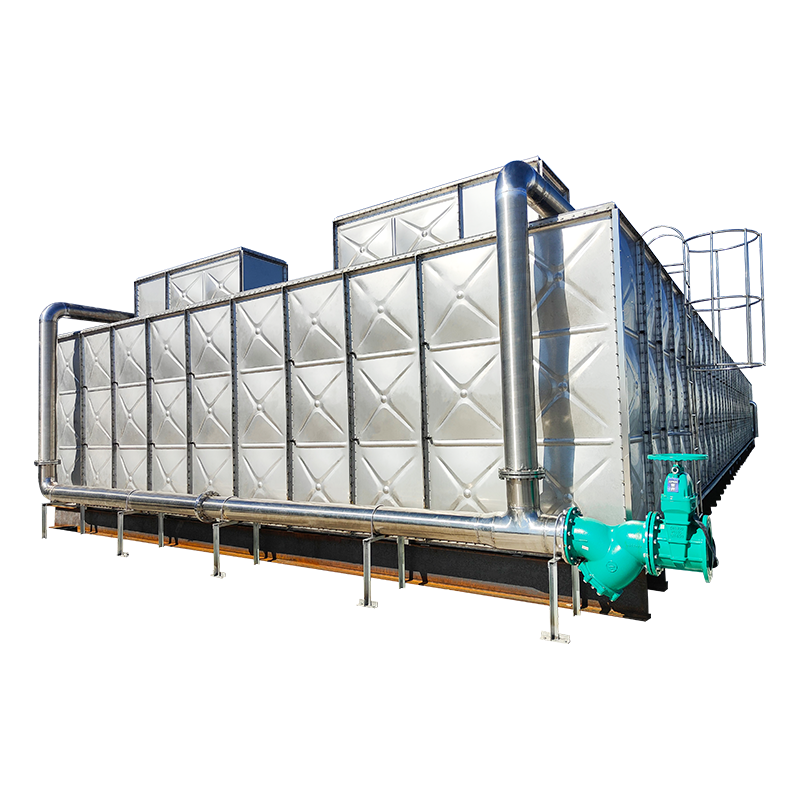
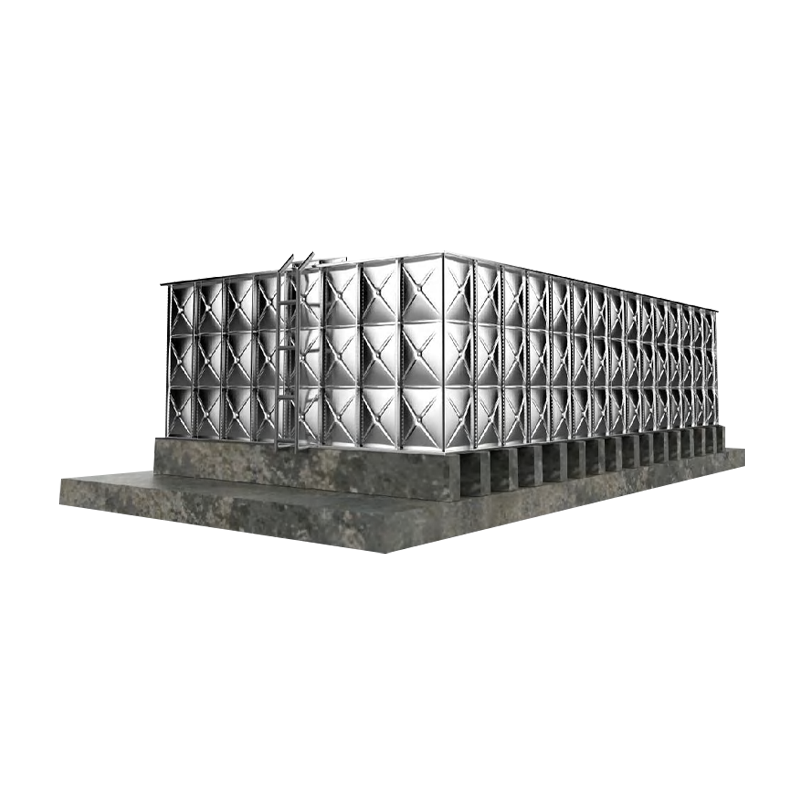
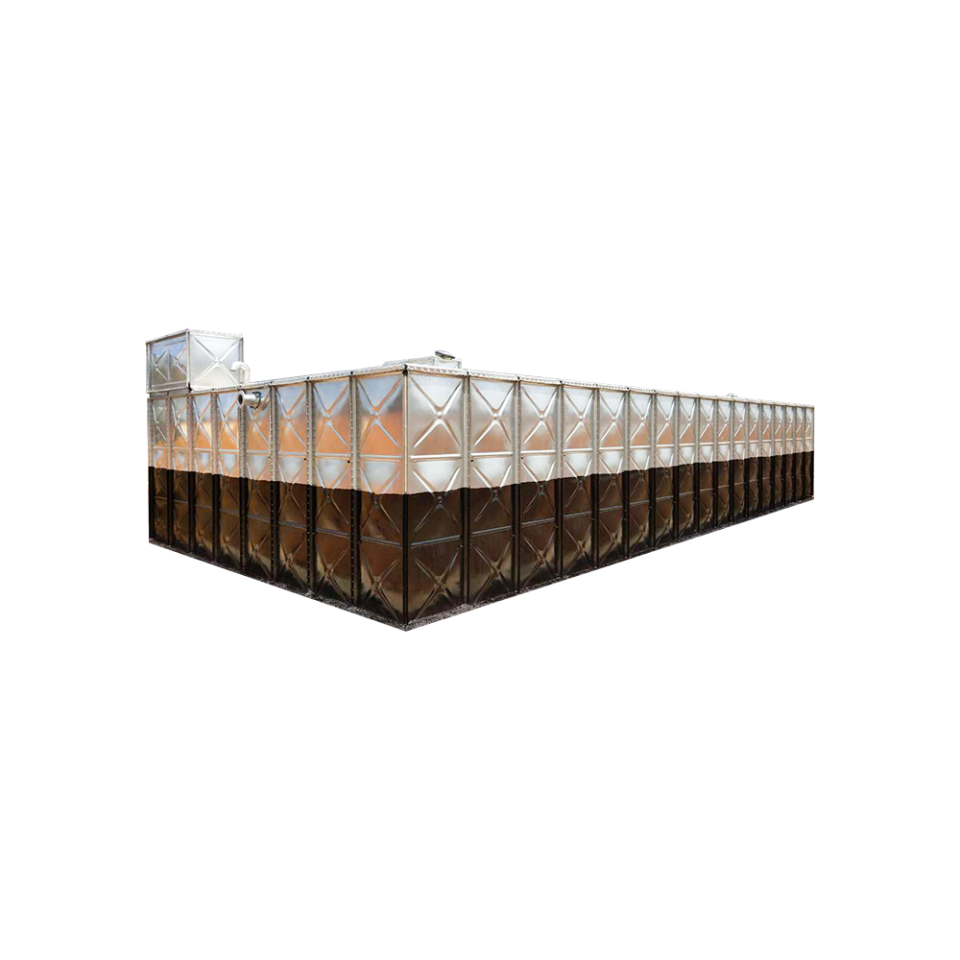
Stainless steel panel tanks are a widely specified solution for fire protection water storage, combining the hygiene and corrosion resistance of stainless steel with the on-site assembly flexibility of a sectional modular system. They are particularly prevalent in commercial buildings, hospitals, airports, data centers, and industrial facilities where the tank must be installed inside an existing structure, where potable water quality must be maintained alongside fire reserve, or where the operational environment is too corrosive for epoxy-lined carbon steel.
Stainless steel panel tanks used in fire protection applications are typically manufactured from Grade 304 (1.4301) pressed and formed panels, bolted to a hot-dip galvanized or stainless steel internal support frame. The panel pressing introduces a structural profile — usually a dimple, corrugation, or reinforcing rib pattern — that dramatically increases panel stiffness and resistance to hydrostatic deformation without increasing sheet thickness beyond the standard 1.5–2.0 mm range used in most commercial systems.
Grade 316 panels are specified for installations in coastal or high-chloride environments, or where the water chemistry — high dissolved solids, aggressive disinfection dosing, or recycled water sources — presents a pitting corrosion risk to Grade 304. The cost premium for Grade 316 is approximately 20–30% over Grade 304 panels and is generally justified for any coastal site within 5 km of salt water or any system using chlorinated recycled water.
Panel-to-panel joints are sealed with food-grade EPDM gaskets compressed by stainless steel bolts at defined torque intervals. The gasket material must be WRAS-approved (UK) or NSF 61-certified (USA/international) for potable water contact — a requirement that applies to fire tanks sharing a combined potable and fire reserve, which is common in smaller commercial installations. Joint integrity is tested hydraulically during commissioning, and the gasket condition should be inspected at a minimum of every five years as part of the tank maintenance program.
For fire protection applications, stainless steel panel tanks are typically supplied with all penetrations factory-drilled and fitted — inlet, outlet, overflow, drain, level sensor connections, and manway — to a project-specific schedule, reducing on-site installation time and the risk of field-drilled penetrations compromising structural integrity or panel corrosion resistance at cut edges.
Related Products

Contact us
Headquater Address
Room 901, Building 17, Lane 1088, Shen Hong Road, Minhang District, Shanghai
Factory Address
No. 1, Mingxing North Road, Tech Innovation Park, Jianhu County, Yancheng, Jiangsu, P. R. China
Amy@mxwatersupply.com
Amy@mxwatersupply.com
Telephone(Whatsapp/Wechat)
+86-18051685983
QR CODE

 English
 Français