Oct 06, 2026
A coastal municipal wastewater station replaced its cast-iron submersible pumps three times in five years. Each failure followed the same sequence: chloride pitting on the volute, a seized mechanical seal, then a flooded motor winding. Five years of replacement units, crane hire, and overtime labor came to nearly three times the price of a single stainless steel sewage submersible pump. That arithmetic explains why more specifiers now treat stainless steel as the baseline material for wastewater duty. This guide covers the material science, the specification decisions, and the installation habits that determine whether stainless steel delivers its designed service life.
Content
A stainless steel sewage submersible pump outlasts cast iron because it resists the two dominant failure modes in wastewater: chloride-induced pitting and hydrogen sulfide attack. Its harder surface also slows grit abrasion, protecting impeller and volute geometry.
Raw sewage carries dissolved chlorides between 100 and 500 ppm, rising near coastlines and industrial catchments. Anaerobic bacteria convert sulfates to hydrogen sulfide, which forms dilute sulfuric acid on metal. On cast iron this produces graphitization, a selective iron leaching: the casing can look intact while losing most of its wall strength.
Plant records from municipal lift stations place cast-iron submersible service life at two to four years in aggressive sewage; equivalent 316 stainless steel units routinely run eight to twelve years.
For municipal sewage, 316 is the default grade; 304 suits low-chloride internal transfer duties; duplex grades are reserved for industrial effluent or coastal sites above roughly 1,000 ppm chlorides.
| Property | 304 stainless | 316 stainless | Cast iron |
| Chromium content | 18 percent | 16 to 18 percent | None |
| Molybdenum | None | 2 to 3 percent | None |
| Chloride tolerance | Up to about 200 ppm | Up to about 1,000 ppm | Very low |
| H2S resistance | Good | Good | Moderate to poor |
| Typical sewage service life | 6 to 10 years | 8 to 12 years | 2 to 4 years |
| Relative first cost | 1.0x | 1.2x | 0.4x |
The molybdenum in 316 is decisive: it stabilizes the passive oxide film and prevents the localized breakdown that causes pitting in chlorides. If the lift station receives industrial process water, sees seawater intrusion, or sits near the coast, 316 removes most of the corrosion risk a 304 unit would still carry. For clean internal transfer below 200 ppm, 304 remains a legitimate cost saving.
The stainless steel body decides corrosion resistance; hydraulics, sealing, and motor protection decide whether the pump keeps running. Six checks cover most procurement mistakes.
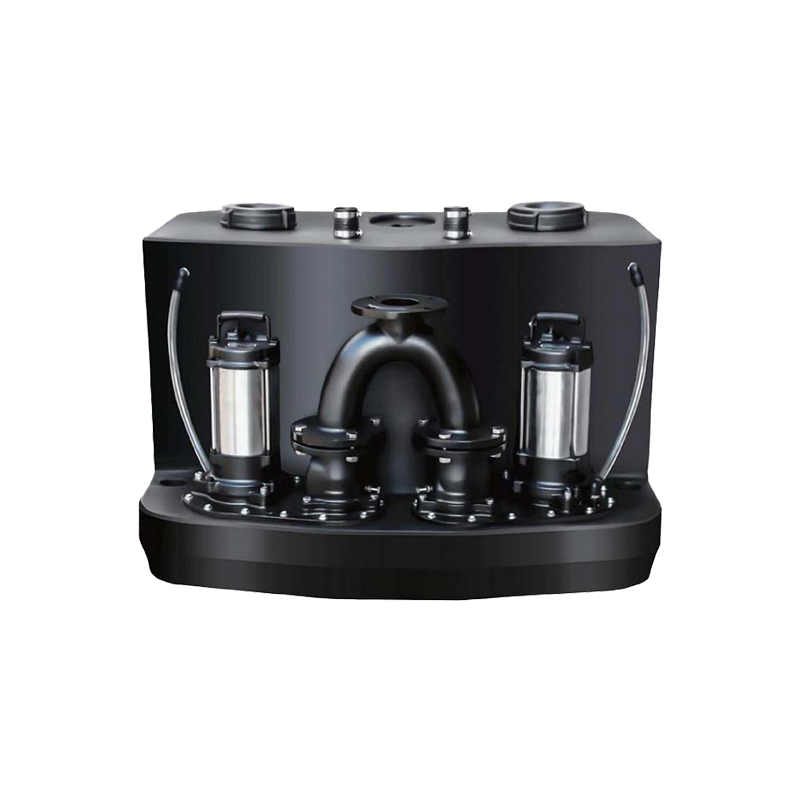
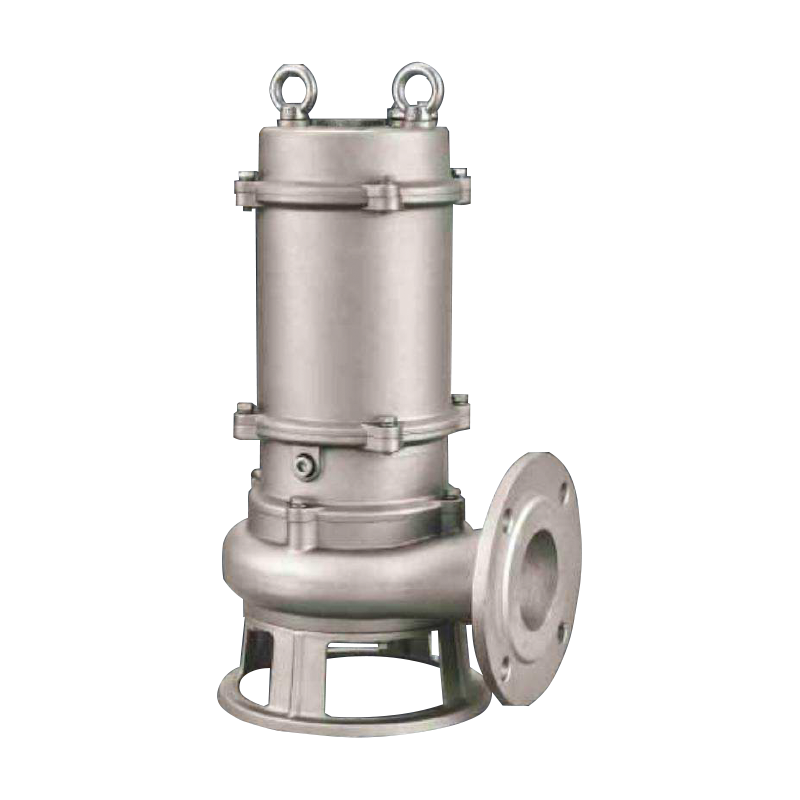 Stainless Steel Sewage Submersible PumpThis corrosion-resistant submersible pump features a two-channel impeller and series mechanical seals. Its IPX8-rated motor with F-class insulation supports reliable operation, but proper system protection remains essential for long service life.View Product →
A corrosion-resistant pump with poor level control, no upstream screening, or dry-run exposure fails as fast as a cast iron unit. The material advantage only appears when the installation protects it.
Guide-rail auto-coupling lets the pump slide down two rails and lock onto a discharge flange, so crews extract it without entering the wet well. For low-flow sites where a heavy submersible is oversized, a packaged sewage lifting device offers an integrated alternative.
Level control comes second. Set the stop level above the motor housing and install a low-level cut-off; an unprotected dry run destroys mechanical seals within minutes. A sticking float switch is a common cause of premature failure.
Debris control upstream is third. If rags and coarse solids are expected, install a bar screen or grinder ahead of the wet well. Stainless steel impellers survive abrasive contact but do not eliminate blockages.
Check fasteners and discharge connections too. Zinc-plated bolts against a stainless casing form a galvanic couple that corrodes quickly; 316 bolts and gaskets keep the wetted path consistent.
A stainless steel sewage submersible pump still relies on precision assembly to deliver its rated life: shaft alignment, impeller clearance, and seal-seat tolerances all influence vibration and seal wear.
Over a ten-year window, a 316 stainless steel sewage submersible pump costs 20 to 35 percent less to own than repeated cast-iron replacements, despite a first-cost premium of roughly 2 to 2.5 times.
A typical cast-iron unit sells for $1,000 to $1,500 and survives about two and a half years, so a decade needs four units plus crane callouts. A 316 stainless unit at $2,500 to $4,000 runs the full ten years with routine seal checks. The margin widens when avoided downtime is included, because each failure carries labor, reporting, and overflow liability.
Yes, within the limits of its free passage size. Standard models pass 50 to 75 mm solids; single-vane impellers handle stringy material better. For unscreened influent, specify a larger passage size or install a grinder; stainless resists abrasion but does not eliminate blockages.
316 is better for sewage duty in most cases because its molybdenum content resists chloride pitting. Choose 304 only for internal transfer with chlorides below 200 ppm; choose 316 for municipal lift stations, coastal sites, or flows with industrial input.
In aggressive municipal wastewater, 304 units typically last 6 to 10 years and 316 units 8 to 12 years, versus 2 to 4 years for cast iron. Actual life depends on duty cycle, solids content, and seal maintenance.
No. Even a stainless pump can suffer seal and shaft damage in a dry run within minutes. Install level controls with a low-level cut-off above the motor housing.
Related Products

Contact us
Headquater Address
Room 901, Building 17, Lane 1088, Shen Hong Road, Minhang District, Shanghai
Factory Address
No. 1, Mingxing North Road, Tech Innovation Park, Jianhu County, Yancheng, Jiangsu, P. R. China
Amy@mxwatersupply.com
Amy@mxwatersupply.com
Telephone(Whatsapp/Wechat)
+86-18051685983
QR CODE

 English
 Français